- Home
- Wildlife in the UK
- Woodland Birds
UK Woodland Birds: A Spring Walk by Sight and Sound
On an early-spring walk in a quiet UK wood, the stillness broke with the soft, repetitive call of one of the first woodland birds to return. The air was chilly, sunlight slipping through bare branches as the first green shoots pushed up from the forest floor. Then that simple two-note phrase rang out again, and I stopped, tilted my head, and smiled. The chiffchaff was back, one of several familiar species you are likely to meet on your own spring walks through the woods.
Common UK Woodland Birds at a Glance
Five birds to know, by sight and sound
- Chiffchaff: a small olive-green warbler. Listen for its clipped two-note "chiff-chaff" call, often heard before it is seen.
- Great spotted woodpecker: black and white with a flash of red. You will hear its fast, hollow drumming on a trunk before you spot it.
- Song thrush: a speckled, arrowhead-marked chest. Sings each phrase three times over, which sets it apart from a blackbird.
- Nuthatch: blue-grey back, peach belly, black eye-stripe. The only British bird that climbs down a trunk headfirst. Sharp "hweet-hweet" call.
- Goldcrest: Britain's smallest bird, with a golden crown stripe. A thin, high call as it flits through the canopy.

Listening for the Chiffchaff
"Listen," I whispered, gently tapping Roger's arm. "Hear that?"
He paused, tilting his head.
"That's a chiffchaff. That clipped two-note call always sounds to me like someone clicked the switch and turned the lights back on after winter."
A moment later I spotted it high in a nearby tree, an olive-green flicker against the branches. "There," I pointed. "That's him. A palm-sized traveller from Africa, announcing that spring is officially here."
Roger gave me a half-smile. "Only you would get this excited about a bird repeating its own name."
I laughed. "Well, it's a pretty good opening act."
The common chiffchaff now has its own page: the bird that sings its own name.
Identifying Woodland Birds by Sound
We walked on, the chiffchaff's chatter fading behind us. Then another sound caught my ear, a fast rhythmic tapping, sharp and hollow, echoing through the trees.
I paused. "That's a great spotted woodpecker."
Roger glanced around. "I don't see anything."
"You'll hear them before you see them," I said. "They drum on tree trunks with their bills to mark territory, like knocking on wood to say, this bit's mine."
Right on cue, a quick burst of drumming rang out across the clearing. Roger grinned. "Surprised they don't get a headache doing that."
I smiled. "Their skulls act like shock absorbers. Perfectly evolved for percussion."
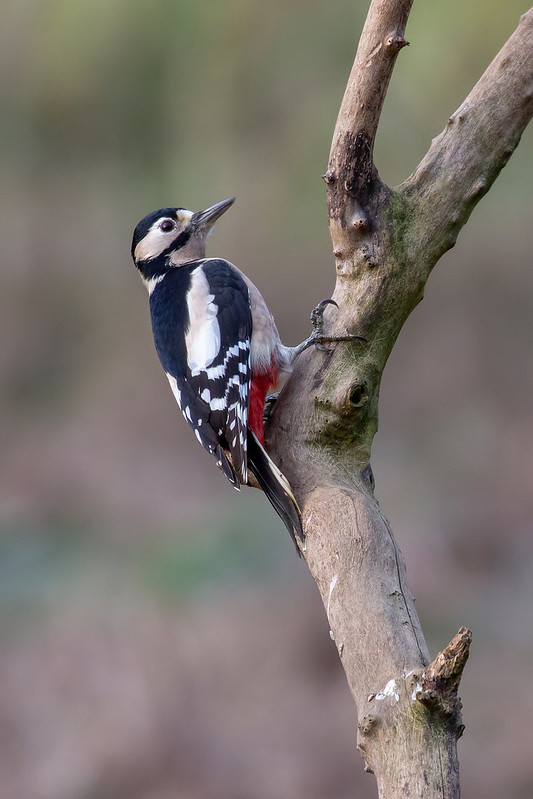
A female great spotted woodpecker: black, white and red, but no red patch on the head
We stood still, scanning the trees, until I caught a flash of black and white trimmed in red. "There. That's the male, see the red patch on the back of his head?"
Roger followed my gaze. "Nature's drummer in full regalia."
More on how colour and markings work: understanding feather patterns and colours. Seen it in the garden rather than the trees? Use what bird is this to identify it by colour, size and song.
Recognising the Song Thrush
We had barely gone a few more steps when a clear, fluting music rang out through the trees. Then it came again, and again, the same phrase repeated three times before changing to a new one.
"Song thrush," I whispered, pausing beneath a sycamore. "They sing each line three times. It's how you can tell them apart from blackbirds."
Roger tilted his head, listening. "It's like an opera."
I smiled. "They're the composers of the woodland. Each one has its own repertoire. Some have over a hundred variations."
He scanned the branches. "Can you see it?"
"Up there." I pointed to a thick branch high overhead, where the bird perched proudly, chest puffed, casting his music into the air like sunlight. Even from a distance I could make out the pale underside speckled with bold, dark, arrowhead-shaped markings, like tiny ink blots painted across his chest.
We stood for a moment, listening to the rhythm of the woodland change around us. "That," I said, "is another sign of spring finding its voice."
Woodland Bird Behaviour: The Agile Nuthatch
We paused by an old oak, its bark furrowed deep with age, when a sudden flicker of movement caught my eye.
"Wait," I whispered, touching Roger's arm. "A nuthatch."
He followed my gaze as a small bird, blue-grey back with peach underneath, darted down the trunk headfirst.
"Most birds climb up," he said. "That one's doing the opposite."
I nodded. "That's what makes them special. Nuthatches are the only British bird that can climb down tree trunks like that."
The nuthatch paused for a moment, clinging sideways with ease. Its black eye-stripe gave it a masked look, part bandit, part superhero. Then its sharp "hweet-hweet" call echoed through the trees before it vanished into a tangle of branches.
Roger smiled. "You really don't miss a thing, do you?"
I shrugged, still watching the tree. "It helps to look twice."
Where I have seen them: nuthatches at Barnwell Country Park in Northamptonshire (a short drive from Oundle).
Britain's Smallest Bird: The Goldcrest
The woodland canopy opened slightly, letting light filter down in dusty beams. I raised my binoculars and scanned the higher branches.
"Remember that day at Spurn Head?" I asked, nudging Roger. "When we watched the volunteer ring the goldcrest?"
He laughed. "The one that fit inside a film canister?"
"Exactly," I smiled. "Britain's smallest bird. Only five grams, lighter than a pound coin."
A flicker of movement caught my eye. "There." A tiny blur darted between twigs, pausing to hang upside down from a larch branch. It picked delicately at the undersides of leaves with a needle-fine bill, its golden crown catching the light for a second, like a spark.
"They're surprisingly hardy," I whispered. "They build spherical nests from moss and hair, bound together with spider silk. Hidden in the branches, like something from a fairytale."
Roger lowered his voice. "And somehow that little thing survives the winter?"
I nodded, still watching. "Some stay here all year while others arrive from Scandinavia in the autumn."
The goldcrest vanished as quickly as it had appeared, leaving the air still and quiet again.
The Investigate Card: Six Prompts for Any Sighting
Next time you stop for a bird you cannot name, run through these six prompts before you reach for a book or an app. Noticing is the skill. The name can come later.
Use this on the first bird you stop for
- Where exactly is it? Habitat plus height (ground / hedge / tree / water / sky)
- What is it doing? Feeding, flying, resting, calling, running, climbing
- Size and shape? A quick comparison (sparrow-sized, pigeon-sized, long and thin, round)
- Two or three standout features? Colour blocks, markings, beak shape, tail length
- Alone or with others? And how are they behaving?
- One thing to check next time? A single next observation to carry forward
Why Woodland Birds Are Worth Slowing Down For
A breeze stirred the canopy above, leaves just beginning to unfurl. The birds had grown quiet, and the woodland seemed to exhale, calm again.
We drifted back to the path. I looked at Roger, and he squeezed my hand, looking up at the canopy as if missing the now familiar bird conversations.
It had not been a long walk. We had not gone far from home. But we had heard the chiffchaff call in spring, a woodpecker hammer its rhythm into bark, watched a nuthatch climb downward like it had its own set of rules, and listened as a song thrush turned the air into music. And for a moment, we followed a goldcrest, bright crown flashing, as it danced through the treetops, lighter than a breath.
We walked home. The woodland birds kept talking, we listened, and that was enough.
If you'd like to turn a woodland walk like this into photographs, here is how I go about photographing woodland on an autumn walk, from light to settings to composition.


Step Behind the Wild Lens
Seasonal field notes from my wildlife walks: recent encounters, the story behind favourite photos, and simple, practical tips you can use on your next outing.
Copyright © 2018- naturewalkswithcarol.com All rights reserved
Home. | About Me | Contact Me | Blog | Privacy Policy