Spot More Wildlife. Take Better Photos. Enjoy the Walk.
Hi, I'm Carol, and I help you spot more wildlife and take clearer photos on the walks you're already doing.
If your camera feels like it has too many buttons and you mostly shoot on Auto, you're in the right place.
If your wildlife photos are often blurred, dark, or too far away, that's normal, and fixable.
If you've only recently started noticing all this, the birds, the seasons, the quiet drama in ordinary places, you're right on time. You're exactly where wildlife watching starts.
I'll keep it simple, so you can enjoy the walk and come home with photos you're pleased with, or at least knowing you looked in the right places. I've been doing this for over 30 years, and I still learn something new on most outings.
Here's all you need for one outing: one walk, one spotting cue, and one simple camera tweak. Each route includes where to look, what you might spot, and the best times to visit, so you're not relying on luck.
And if the wildlife doesn't cooperate? You'll still leave knowing you were in the right spot, watching in the right way. Some days that's the win.
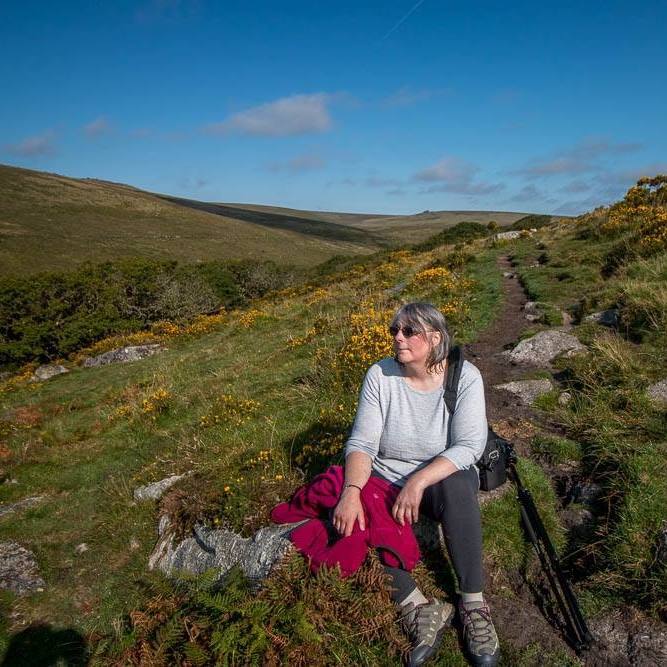
Taking a breather on Dartmoor, Devon
I'm based in Cambridgeshire on the Northants border. Most routes here are local favourites I return to again and again, with occasional trips further afield.
There's one place I head to where I have never seen another living human. Out the back of the village churchyard, where the grass can't have seen a mower for years, is my secret spot. I am never alone, there always seems to be a blackbird on the lichen-covered headstone as I turn the corner. Although he has his back to me, he immediately jumps onto the ground to search for worms leaving me watching, and being watched by a charm of goldfinches.

A Method, Not Just Luck
If you've got time to spend outdoors, whether that's a spare hour or a whole morning, I'll help you use it well.
You don't need expensive kit to start. I'll show you how to use what you already have, your phone, a compact camera, or an entry-level camera, to get photos that aren't blurred, dark, or tiny in the frame.
You'll also pick up some fieldcraft basics: how to walk quietly, where to position yourself, and how to move so wildlife carries on being itself. That instinct you have about not wanting to disturb anything? That's not a weakness. It's the foundation of good fieldcraft, and it means you're already thinking the right way.
Especially for birds
You'll learn where to look, what to listen for, and what bird behaviour tends to do next, so you're not always a second too late. It's anticipation, not fast reflexes, that gets the shot.
Each walk guide includes a simple way to read the conditions: where the light falls, where wildlife tends to appear, and what to do if nothing's showing. You'll build a quiet practice you can return to, where even slow days sharpen your eye.
No gimmicks. No expensive kit lists. Just a calm approach that rewards patience and attention.
What you might spot right now
Nature shifts with the season. Here's what's worth looking for this autumn:
- Hedgerows: redwings and fieldfares arriving to strip the berries, blackbirds joining the feast
- Fields: lapwing flocks wheeling over the ploughed fields, common cranes back on the washes
- Lakes: wigeon and teal returning for the winter, the first goldeneye arriving
- Woods: jays burying acorns, fungi pushing up through the leaf litter, the trees turning
Curious what changes through the rest of the year? See what to notice in every season, with the walks and guides for each.
Quick Guides for Your Next Outing
- Nature Walk Checklist – what to bring, what to wear, what to notice first
- Nature for Beginners – you belong here, even if you can't name anything yet
- What Bird is This? – simple ID help without the overwhelm
- How to Start Wildlife Photography – no expensive kit required
- Simple Editing for Wildlife Photos – keep it natural, keep the memory true
Been here before? Head to What's New for the latest walks, wildlife guides, and seasonal stories.
From the Field
Find a Walk by County
Official maps don't tell you the useful bits. Mine do: what you're likely to see, when it's best, and the small details that make a walk feel easy.

Nothing pushy, just field notes, seasonal sightings, and simple tips you can actually use.

Step Behind the Wild Lens
Seasonal field notes from my wildlife walks: recent encounters, the story behind favourite photos, and simple, practical tips you can use on your next outing.
Copyright © 2018- naturewalkswithcarol.com All rights reserved
Home. | About Me | Contact Me | Blog | Privacy Policy