- Home
- Wildlife in the UK
- How to Identify Wild Birds
- How to identify birds from their flight
Identify Birds from Flight Style
Most birds don't wait for you. They cross a gap in the hedge, lift off a fence post, or pass overhead while you're still getting the binoculars up, and they're gone before you've seen a single marking.
That isn't a failed sighting. It's the ordinary one.
When a bird disappears too quickly to identify properly, the way it moved through the air can still narrow it down to a sensible shortlist. Notice the movement first, then add shape and setting. A brief fly-past rarely gives you enough for certainty, but it often gives you enough for a good next step.
The short version: movement first, certainty second. A shortlist of two or three birds is a real result, not a failure to identify one.
A fly-past can still tell you something
There's a habit worth breaking early, and it's the one where a bird goes past, you don't get the colours, and you write the whole thing off. Nothing seen, nothing learned, back to square one.
But you almost never see nothing. You see movement. And movement is one of the few clues that survives bad light, a long distance, a bird against a bright sky, and the two seconds you had to look at it.
Think about what a silhouette against grey cloud gives you. No colour. No markings. No bill detail. What it does give you is a rhythm and a path through the air, and those two things are often enough to take you from "a bird" to "one of three or four birds".
That is a fairly typical view of a bird: small in a lot of empty sky, no colour to speak of. And it is still identifiable, because of what it's doing rather than what it looks like.
Here's a note I took on a dog walk.
Chance to get out to the fields today. It hasn't rained too much. On passing the horse field, we heard a yaffle, shouting out loud.
Moments later I spotted the bird as it passed in front of the far hedgerow. From this distance, it looked quite yellow rather than green, but it was definitely a green woodpecker. I recognised the flight pattern.
That is the whole argument of this page in one sighting. The colour looked wrong, so anyone matching it against a picture in a book would have hesitated or given up on it.
The flight did not lie, though. Flight pattern survives distance and poor light, and colour does not.
You don't need to name something right away
If you get as far as "something that bounced" or "something that hovered", you've done the part that matters. The name can wait for the next time you see it, and there usually is a next time.

Use a movement-first routine before the bird is gone
The reason a fly-past feels like chaos is that there's no order to what you look at. You try to see everything at once, and then remember none of it. A fixed order fixes that, because you're no longer deciding what to look at while the bird is leaving.
Notice the rhythm first
Before anything else, ask whether the wingbeats are steady or intermittent. Is it flapping continuously? Flapping then pausing? Barely flapping at all?
Rhythm registers faster than detail, and it's the part you can still describe to yourself thirty seconds later when you're writing it down or dictating into your phone. Steady beats, bursts with pauses, and almost no beats at all are three genuinely different groups of bird.
Then notice the path through the air
Now look at the line the bird is taking. Is it straight and level? Rising and falling in a regular wave? Circling and rising? Holding still in one spot? Changing direction sharply and often?
A path is easy to remember because you can draw it with your finger. If you can trace the shape it made in the air, you've captured the clue.
Finish with shape and setting
Only now go for tail shape, wing impression, rough size, and where you were standing. A forked tail, a fanned tail, long wings or blunt ones, over water or over a field, alone or in a group. These are what turn a movement into a shortlist.
Why this order: rhythm survives the worst viewing conditions, the path survives the second-worst, and the fine detail is the first thing you lose. Pick up on the obvious clues while you can still get them.
What the common flight styles look like in plain English
Bird books use a small set of words for flight, and they're worth knowing because they're what you'll meet everywhere. None of them is complicated once you have matched it to something you've seen.
- Bouncing, or undulating. A regular rise and fall, like the bird is travelling along a gentle wave. Bursts of flapping lift it, then it dips as the wings fold.
- Steady flapping. Continuous, even beats with no obvious pauses and a fairly level line.
- Hovering. Holding position in one spot in the air rather than travelling anywhere.
- Soaring. Circling and gaining height with very little flapping, riding the air rather than beating through it.
Four words. That's the whole vocabulary, and between them they cover most of what crosses a garden or a field. But don't let this list stop you from creating your own descriptions, they are just as valid and will probably stitck in your head longer.
How to turn one movement clue into a sensible shortlist
The way it moves, on its own, rarely names a bird, because flight styles are shared. Plenty of small birds bounce. Several birds of prey soar. The clue narrows the field, it doesn't close it, and the skill is knowing the difference.
What makes a shortlist honest
A simple shortlist says what you saw and stops there. "A bouncing flight, sparrow-sized, over the garden" is honest. "A goldfinch" is a guess wearing a name badge, and it labels a sighting before you have had a chance to verify it.
I get this wrong too, and here's one where the camera put me right.
At Kilnsea Wetlands in Yorkshire we were watching the roosting birds early on an October morning, when everything suddenly took off. Searching the sky I saw a bird of prey. A peregrine! It was flying so fast I only managed a couple of photos. When it came to editing the pics I was delighted to have captured the bird in the frame. Zooming in I realised the stripes were going the wrong way. The bird had been a hobby instead.
I had already named it in my head before getting home. If I had not taken the photos, I'd have forever believed I'd seen a peregrine.
Narrowing it down gives you some leeway. Recording, "I think it was either a ... or a ..." gives you more chance of being right.
What to add after flight style
Once you've got the movement, four things tighten the list faster than anything else:
- Tail shape. Forked, fanned, square or long. Visible in silhouette when nothing else is.
- Where you were. Over water, over farmland, along a hedge, above a road verge. Habitat rules out a surprising amount.
- Alone or with others. A single bird crossing a field and a loose flock feeding over a lake are different situations.
- What the wings show when they open. Some markings only exist in flight. A pattern the bird has to fly to show you is a different thing from body colour in poor light, and it is far more reliable.
Redshank are the easy example. On the ground they're a grey-brown wader with orange legs, and so are several others. In the air they hand you that white trailing edge and the white wedge up the back together, and that combination is redshank and nothing else.
It's worth keeping this separate from colour, because further down this page you'll be told not to trust it. Body colour in poor light does lie. A marking that only appears when the wings open is a different animal: the bird has to fly to show it to you, and it shows it the same way every time.
```Four fly-past patterns worth learning first
These are the ones I'm surest of, the flight styles I can put a name to before I've noticed anything else about the bird. They're a good starting four because the birds are common, they're spread across different habitats, and they look nothing like each other in the air.
The bounce: green woodpecker
Green woodpeckers have a bouncing flight. This describes it very well, and it's also the word the RSPB use, so you don't need to get fancy. I always think of them as a slightly overweight gentleman of a certain age. They are still active, but seem to run out of energy every now and then and need a little boost, or they would end up on the ground.
The bounce is shared with finches, which are far smaller and bounce more lightly. So it doesn't narrow you to a kind of bird at all, because a woodpecker and a finch are not related. What it narrows is the shortlist, and size does most of the separating from there.
The steering tail: red kite
Red kites twist and turn their forked tails like a rudder. That is the thing to watch, and once you have noticed it, the bird is unmistakable, because almost nothing else in a British sky steers that way.
Although their tails are busy, their wings are more relaxed, as warm air currents keep them in the air without the need for constant flapping.
If you miss that distinctive tail, you might find yourself confusing the red kite with the common buzzard. Both are large birds of prey, and kite numbers are increasing in some areas. The buzzard's tail is broad and blunt, and often fanned out in flight, and the wings have a more squared-off appearance.
Two of my own kites, taken a few weeks apart. Look at the tail in each one. It is in a different position relative to the body, and that's the bird steering.
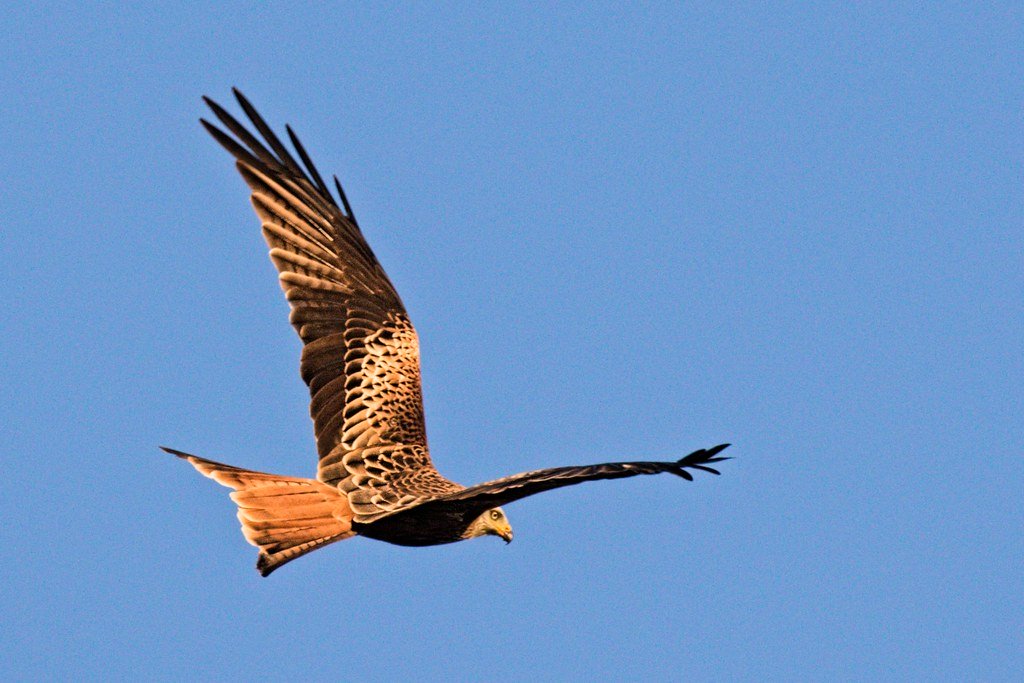
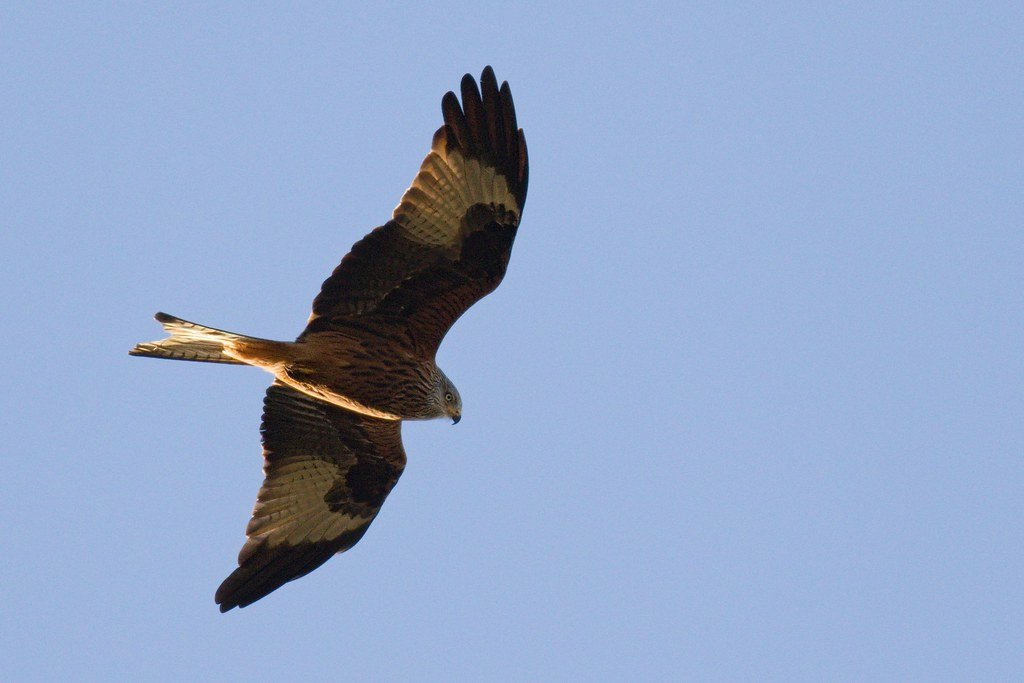
From below: the fork is unmistakable, and the tail is twisted away from the line of the body.
The second one also shows the two other things worth knowing in silhouette: pale patches under the wings, and dark fingered tips.
The hover: kestrel
What if the bird appears to not be moving? Just hanging in the air? It is most likely a kestrel. No other British bird routinely hangs in the air over open ground like this, so it is a safe call.
You have a longer window for viewing here as the bird will hover over a road verge, field or piece of rough ground. If you study it closely you may see the wings and tail are moving, but the kestrel isn't going anywhere. The head will stay level and still until it sees what it's seeking. Then it will swoop down to catch its prey.
The rise and tumble: skylark
This is the one I had to work out for myself, and it is the best argument on this page for watching before naming.
We went to Yorkshire to see the nesting peregrines on Malham Cove, and we saw them, but from a long way away. We didn't have a long enough lens to photograph them properly.
What we also did was go to Malham Tarn, which is like an inland lake. Walking towards the water, this little bird jumped up out of the long grass, flew up into the air, spiralling, singing its heart out, and then spiralled back down to the ground again. I didn't know at the time what it was. I heard the same song from a different place and looked around. There was another one, and I looked back, and there was the first one with another one next to it. They were all jumping up in the air and spiralling around, flying straight up and then tumbling back down again.
Eventually, I worked out that they were skylarks, and I spent a happy time sitting on the edge of the water, watching the skylarks. That wasn't what I went there for, but it was good fun. When we got home, I took the dogs for a walk across the road into the field, and there were skylarks there, so I didn't have to go all the way to Yorkshire to find them. They were literally on my doorstep.
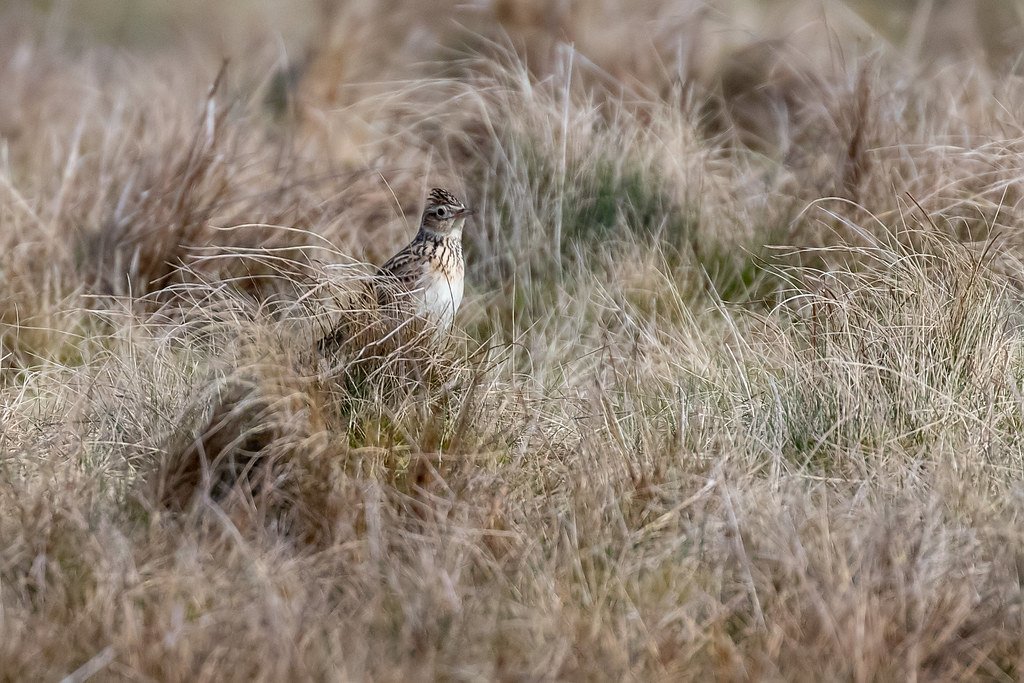
On the ground you would walk straight past it.
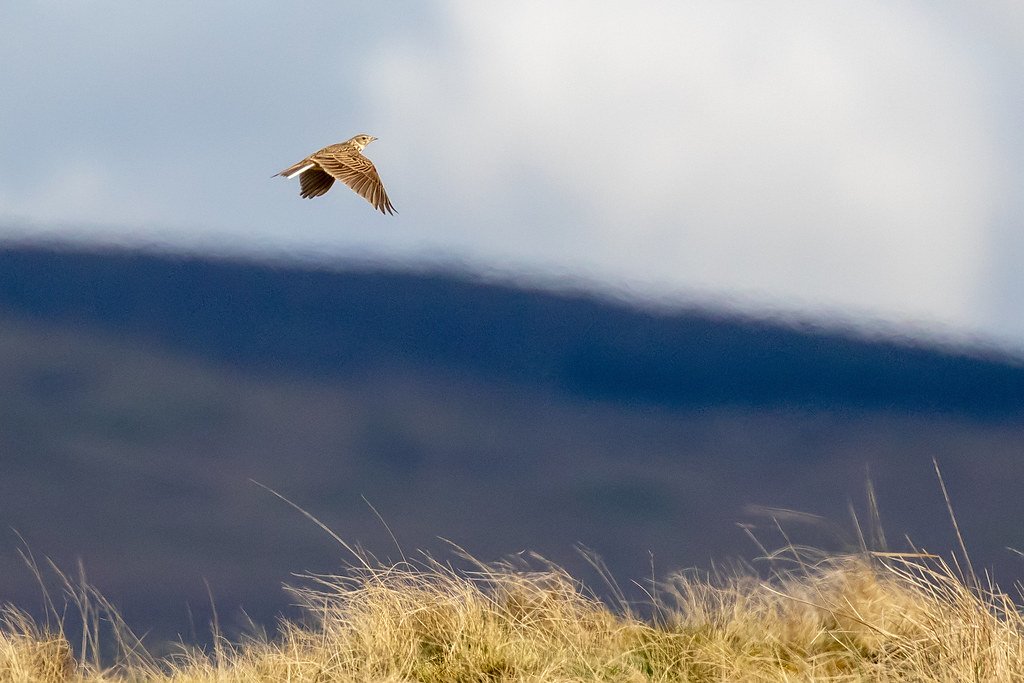
In the air it tells you exactly what it is. Malham Tarn, Yorkshire.
The proper name for it is the song-flight, and the shape of it is the clue: up off the ground almost vertically, then held high and steady for a long time while the song pours out, then down again in stages. Nothing else in a British field goes up like that and stays there singing.
It is worth setting beside the kestrel, because both of them hang over open ground and they are easy to muddle. A kestrel is low, silent, and facing into the wind with its head down. A skylark is high, loud, and not looking at the ground at all.
When they fly together, the group has a shape of its own
Everything so far has been one bird. A lot of what crosses a winter sky is a crowd, though, and a crowd hands you a different kind of clue: the shape the group holds, and whether it keeps that shape or keeps changing it.
This is the clue that works at the greatest distance. A single bird at half a mile is a dot with no detail at all. A flock at half a mile still has a shape, and often a sound.
Geese: the line, and the noise that arrives first
Geese fly in a skein, the proper word for that trailing V shape or long, wavering line. It is the most recognisable shape in the sky. You will nearly always hear them before you see them: honking and cackling, or the higher, squeakier "wink wink" of pink-footed geese, a sound that carries well ahead of the birds themselves.
Which geese they are is a separate and harder job. Greylags are bigger, sturdier birds with an orange bill and a nasal honk. Pink-footed geese are smaller and more compact, with a higher-pitched call. Canada geese are the loud, familiar ones from the park lake. But the skein alone tells you "geese" from a very long way off, and on a page about movement, that is the part that counts.
Mine came at the other extreme, close enough that I flinched.
I can remember the time beside Thrapston Town Lake when my husband and I were walking along the footpath and a cacophony of sound made us both look to our right. Whump, whump, whump. A flock of about 20 Canada Geese flew straight at us and passed just over our heads, heading for the water. Their legs dropped and their feet stuck out in front of them, ready to touch down, and I ducked, sure they were going to crash into us. It was a spectacle of numbers, and we didn't get a chance to see them from far away. But they were flying in a triangular formation with one out front, honking as they flew, so there was no doubt about their identification.
Two things there are worth pulling out. The first is that the sound arrived before the birds did, and it was not only the honking. "Whump, whump, whump" is the noise twenty sets of wings make, and no book is going to tell you that.
The second is that the identification was never in question, even at that range, because the triangular formation and the calling did the work that colour and markings would usually be asked to do. So the flock clue holds at both ends of the scale. Half a mile off it is all you have. Directly over your head it is still the thing that names them.
And yes, I ducked
Thirty years of this and a flock of geese coming in low still made me flinch. Being startled by wildlife is not a sign that you are new at it.
Lapwings: the flicker
A winter lapwing flock does something no other flock quite does. The birds have broad, rounded wings, dark above and white below, so when the whole flock flaps together it flickers between black and white.
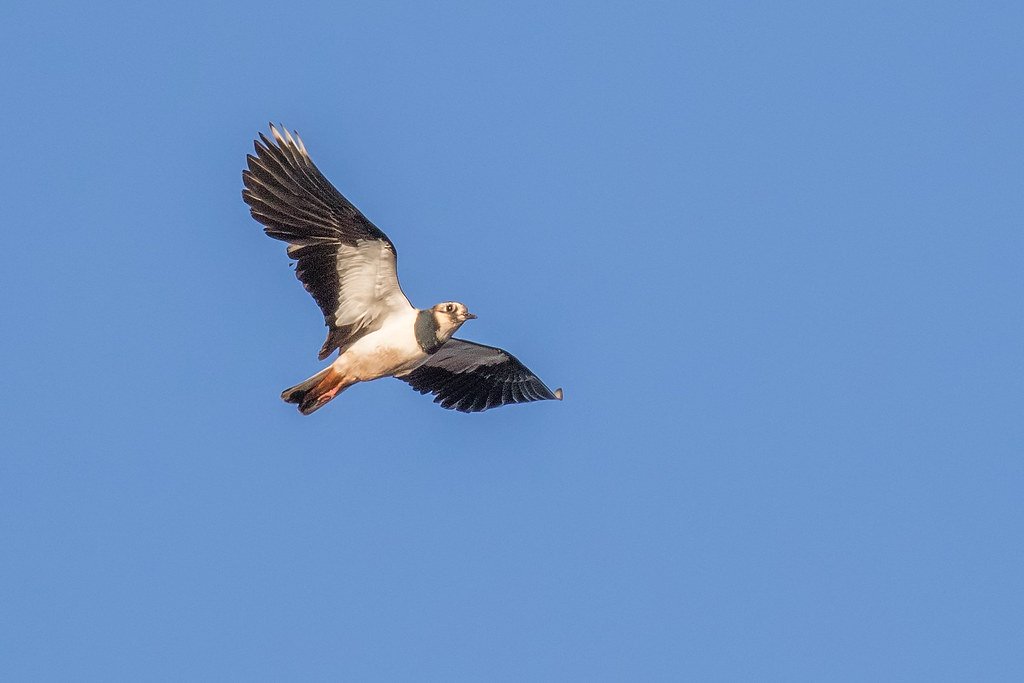
One bird: broad rounded wings, dark above and white below.
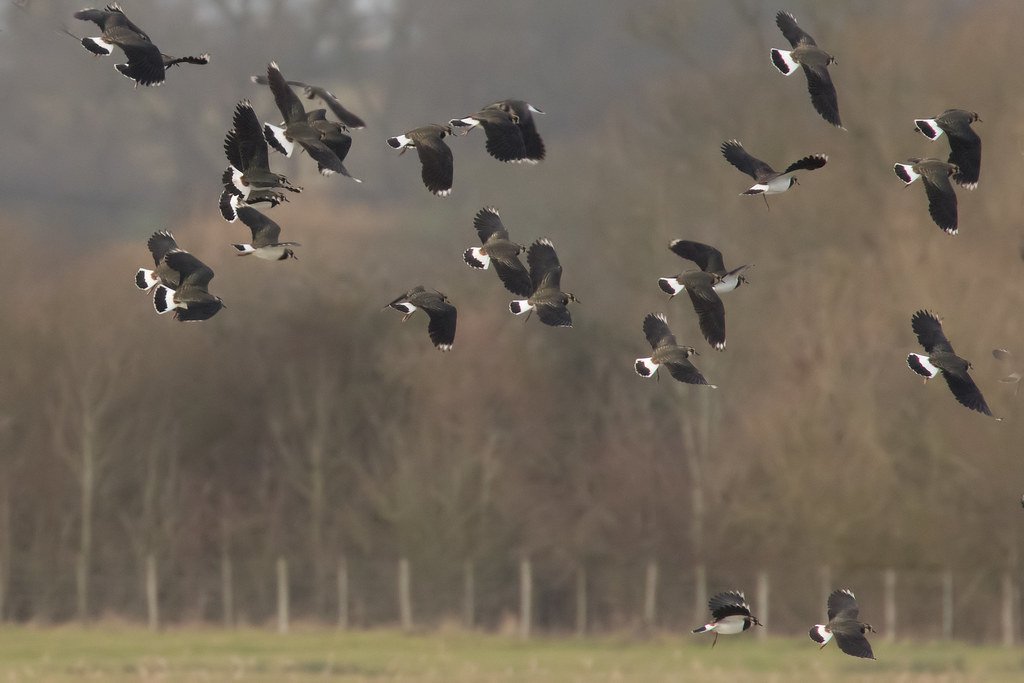
Twenty of them doing it at once, in January. That is the flicker.
The name comes from exactly that. "Lapwing" is thought to come from an Old English phrase meaning "leap with a flicker in it". It is not the only British bird named after the way it moves either: a kestrel's old country name is the windhover. When a bird has been named for its flight, that is a fairly strong hint the flight is worth learning.
Waders: the tight mass that flashes
A flock of small waders over an estuary moves as one tight body, turning together so the whole mass flashes from dark to silver and back as the birds show you their backs and then their undersides.
It is the lapwing's trick again, done faster and by more birds. Worth knowing even if the species stays a mystery: a tight, fast-turning, flashing flock low over mud or water is waders, and that on its own narrows the field enormously.
There's a second thing a wader flock does, and it's easier to miss because it happens on the ground.
On our 2021 visit we were walking along the sea wall when a whizz of sound went overhead. It was a large flock of Knot coming in off the sea. Followed by another, and lots more groups. They all landed and almost melted into the surroundings. When you really looked carefully, or through the telephoto lens, you could see the movement of thousands of birds all together. Quite a spectacle. I could hardly believe I hadn't seen them at all until the first group that flew over me joined them.
I have no photograph of that morning, and the reason is the story: I couldn't pick out a single bird well enough to be worth keeping.
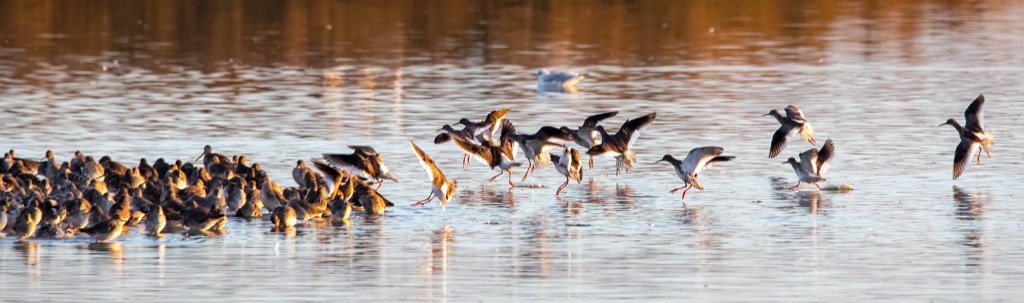
Redshank dropping in to join a roost already packed with birds, Kilnsea Wetlands at high tide. The same thing happens at Frampton with knot, and at both places the arriving group is what gives the rest away.
The sound came first, which is often how a wader flock announces itself. And the birds on the ground were invisible until the ones in the air landed among them, which is the honest reason to keep watching a stretch of mud that looks empty. If a group comes in and lands on nothing, look harder at the nothing.
Why this one is worth having: a flock is readable at distances where a single bird is only a speck. On a big empty winter sky it is often the only thing out there you can read at all.
What makes flight style harder to read
Flight style is a good clue, not a perfect one, and it is worth knowing when to trust it less.
Wind flattens the pattern
A strong wind changes how a bird flies. A bounce gets shallower, a glide gets shorter and more hurried. On a rough day, weight the clue less and lean harder on shape and habitat.
Distance flattens the path
A long way off, a rising and falling flight looks almost level. If the bird is a speck, be suspicious of any judgement about the shape of its path.
A bird in a hurry flies differently
A bird that's been startled, or is being chased, drops its usual style and just goes. What you're watching then is panic, not the species.
Trusting the colour, or the size
Both of them lie in a poor view. A green woodpecker looks yellow across a field, and a bird alone in the sky has nothing beside it to be measured against. Movement is the clue that holds up when those two have stopped being reliable.
Wanting it to be something
The commonest error of the lot. If you've been hoping for a particular bird, you'll see its flight in something else. Write down what moved, before you write down what you think it was.
Flight style questions
Can you identify a bird from flight style alone?
Sometimes, and only for the distinctive ones. A red kite working its tail is close to certain, because very little else steers that way. A small bird bouncing across a garden is not, because too many species share it.
Even hovering is not quite the certainty it's made out to be. Buzzards hover too, and they do it most noticeably in a strong wind, which is exactly when you would be tempted to call a hovering bird a kestrel. Flight style is at its best as the first clue rather than the only one.
What should I notice first if the bird is already disappearing?
The rhythm of the wingbeats. Steady, broken into bursts, or barely there at all. It is the clue that survives the worst view, and it's the one you'll still be able to describe when you write it down.
What if I can only narrow it to two or three birds?
Then you've identified it as well as the sighting allowed, and you have a specific thing to check next time. Two or three candidates and a question for next time beats one confident name that turns out to be wrong.
Is flight style better than colour for brief sightings?
For brief sightings, usually yes. Colour needs decent light and a reasonable distance, and a bird against a bright sky shows you almost none of it. Movement carries much further and survives conditions that wipe colour out completely.
Where's the best place to practise?
Somewhere with open sky and a hedge or treeline: a field edge, a park, a reservoir path, or a road verge on a walk you already do. You want birds crossing gaps, because a gap is what gives you the two seconds of clear view.
Where to go next
Flight style is one clue among several, and it works best alongside the others. These take you to the rest of them.
Start with one bird instead of all of them
The calm way in when every hedge seems to move at once and nothing holds still long enough to name.
Filter it down by colour, size and habitat
The garden bird identifier. Useful when the bird did sit still and you got a proper look at it.
Read a bird's beak and learn what it eats
Beak shape tells you how a bird feeds, which tells you where to expect it next time.
Why the same bird looks different in spring
Feather patterns, breeding plumage and moult, and why a familiar bird can stop looking familiar.
Next time something crosses a gap and you don't get the colours, you've got somewhere to start. Watch how it moved, keep the two or three birds it could have been, and go back to the same spot. That's the whole practice, and the second sighting is always easier than the first.


Step Behind the Wild Lens
Seasonal field notes from my wildlife walks: recent encounters, the story behind favourite photos, and simple, practical tips you can use on your next outing.
Copyright © 2018- naturewalkswithcarol.com All rights reserved
Home. | About Me | Contact Me | Blog | Privacy Policy