- Home
- Where to see Wildlife
- Northamptonshire walks
- Pitsford Water
Pitsford Water Nature Reserve
Despite living close to Pitsford Water, we have only recently discovered this Northamptonshire reserve. Pitsford Reservoir is split in two by a causeway, and the smaller area to the north is the nature reserve.
Visiting Pitsford Water (Pitsford Reservoir)
The reserve sits beside Brixworth, just north of Northampton in Northamptonshire. You need a permit to enter the reserve, bought from the Fishing Lodge and free for members of the Bedfordshire, Cambridgeshire and Northamptonshire Wildlife Trust. It is a seven-mile walk around the whole reservoir, with eight bird hides spread along the shoreline. There are two car parks: the Fishing Lodge on the reserve side, and a Pay and Display at the far end of the causeway. Dogs (apart from guide dogs), cycling and jogging are not permitted, so disturbance to the wildlife stays low.
The reserve is a Site of Special Scientific Interest. Wildfowl numbers are significant in winter, and breeding birds arrive in spring.
On our first visit we parked at the Fishing Lodge and headed right, along an accessible gravel path to the first hide.
Wear suitable footwear
I made the mistake of not changing into my walking boots, and my feet were soon soaked.
The reserve is not circular. The best way I can describe the shape is to spread your thumb and first two fingers as far apart as possible, then imagine a line joining the base of your middle finger and thumb. That line is the causeway. This means the far bank is never too far away, offering good views of the wildfowl on the water.

Goosander Hide
Our first visit was in early October, and some overwintering ducks had already arrived. We spotted Great Crested Grebe with their stripy-headed youngsters, perhaps a second brood. Numerous Mute Swan, Greylag and Canada Geese were present, along with Little Egret. We were surprised to see three male Pheasant on the shore across from the hide.
A handy notice on the hide door showed how far away the next hide was in each direction. The Lagoon Hide was just over a mile in the direction we had been travelling, so that became our next destination.
Lagoon Hide
I think we must have gone the long way around, as it felt like more than a mile before we reached the next hide. Or perhaps it was because I was carrying two cameras and a heavy tripod with a gimbal head. It was a pleasant walk through woodland, with occasional glimpses of the water through the tree line. We rounded Holcot Pond and headed back along the other side of Holcot Bay.
The only disturbances were a noisy flock of Canada Geese flying overhead and an angry squirrel who swore at me from a tree. Until this point we hadn't met a single person at Pitsford Water since leaving the car park.
On reaching the hide I set up the tripod and opened the hatch quietly, so as not to disturb any birds. The water level in the lagoons was low after a long, hot summer, but there were birds around. The most noteworthy was a Green Sandpiper bobbing along at the water's edge.
A Little Egret came close, allowing some good photos. I used spot metering and exposure compensation here to avoid overexposing the white feathers. You can find more on this on my camera settings page. There were more pheasants around too, their plumage gleaming in the sunshine.
Maytrees Hide
The next hide was some distance away, so we decided to head back to the car and drive across the causeway, park up, and walk to the Maytrees Hide and bird feeding station from there.
The access to this hide was open, with no screened boardwalk to hide our approach. Many of the birds took off as we got closer. The Mute Swans didn't seem too bothered, and one posed for me.
Hubby was now getting restless and hinting that he had had enough for one day, so we headed back to the car. By this time my feet were sodden, so we stopped at a supermarket on the way home to buy some dry socks.
Sadly, we later learned that in November 2024 a fire engulfed Maytrees Hide, sparked by fireworks placed around its exterior and in the bird-seed bin. Was this sheer vandalism, or a misguided attempt at celebration? Fortunately the fire didn't spread to the adjacent bird-ringing area, which could have caused far greater ecological harm. The hide was lost, but the surrounding habitat remains intact.
Return Visit to Pitsford Water
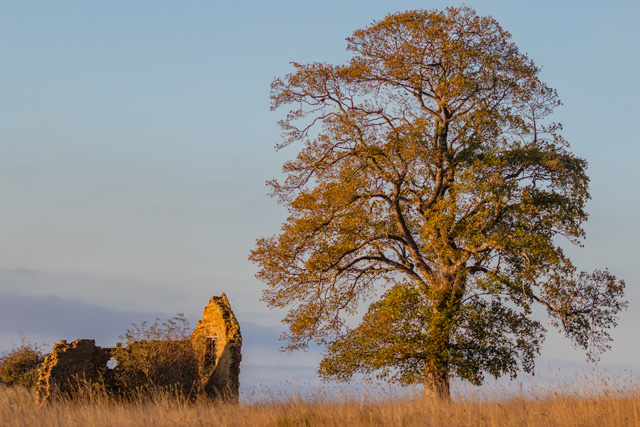
A ruined cottage catching the golden hour light
Two weeks after our first visit, we returned. This time we parked at the other end of the causeway, in the Pay and Display car park, and went anticlockwise around the reserve. Yes, I did remember to change my shoes this time.
We had arrived just after sunrise and enjoyed the golden hour. This ruined building was visible from the road when I looked back towards the parked car. We began with a quick visit to the Maytrees Hide. Plenty of wildfowl were around, but nothing close enough to photograph, so we continued through Scaldwell Meadows, which gave great views of the water from the path.
Bird Club Hide
The Bird Club Hide was soon in view, as there is only about half a mile between the first few hides on this side of Pitsford Water. A screened boardwalk leads from the path through the trees down to the hide, obscuring our presence from the wildlife as we approached.
This was the best vantage point of the morning, as we had the rising sun behind us. I was happy to see a Great White Egret near the shore and trained my lens on it. The elegant white bird obliged by continuing to fish, and soon caught a sizeable breakfast.
While watching the egret, a flash of chestnut caught my eye in the distance. A fox was walking behind the trees and across the shore. When it reached a fallen tree it climbed up and watched the ducks on the water. The birds that spotted it took flight in panic, but it didn't seem too interested. It made itself comfortable and lay down to rest in the sunshine, giving me ample time to photograph it.
New James Fisher Hide and Scaldwell Hide
Hubby eventually dragged me away from the egret, and we walked on to the next two hides, both reached by the same boardwalk. They give slightly different angles over Scaldwell Bay, which was handy, as all we could see from the first were silhouetted birds due to the angle of the light.
Scaldwell Hide offered a close view of a Lapwing, though I had to wait until it turned so the light caught its plumage. When we first moved to Cambridgeshire in the 1980s there were huge flocks of these birds in the fields around us. Sadly that is no longer the case.
We didn't linger. As we opened the hide door, a male pheasant was walking down the boardwalk towards us. He changed his mind when he saw us and turned tail. It was time for us to change direction too, and head back to the car.
Next time we might get as far as the Bird Ringing Hut and Willows Hide, which looks over Scaldwell Bay from the opposite shore. That would still leave three hides around Walgrave Bay for another visit.
On our way back we popped into the Bird Club Hide again to see what else was about. I am so glad we did, because Pitsford Water had more to give. A pair of Red Crested Pochard swam past, a species not often seen in our area. I waited for the light to catch them and took what I thought would be my last photos of the day.
As we drew close to the Maytrees Hide once more, a Great White Egret flew past, so I couldn't resist a few more images. And as we neared the car, a Common Buzzard flew over. I quickly changed my settings and caught it against the bright blue sky.
A lovely ending to the morning. I am certain we will be back at Pitsford Water before too long.
More Nearby Walks
Another Northamptonshire walk with lakes, hides and good chances of seeing wildlife.
For butterflies and woodland instead, visit butterfly-rich Fermyn Woods Country Park.
A larger reservoir nature reserve nearby, from winter waterfowl to summer ospreys.
A Cambridgeshire reservoir reserve with eight hides and a nine-mile circular walk.


Step Behind the Wild Lens
Seasonal field notes from my wildlife walks: recent encounters, the story behind favourite photos, and simple, practical tips you can use on your next outing.
Copyright © 2018- naturewalkswithcarol.com All rights reserved
Home. | About Me | Contact Me | Blog | Privacy Policy